

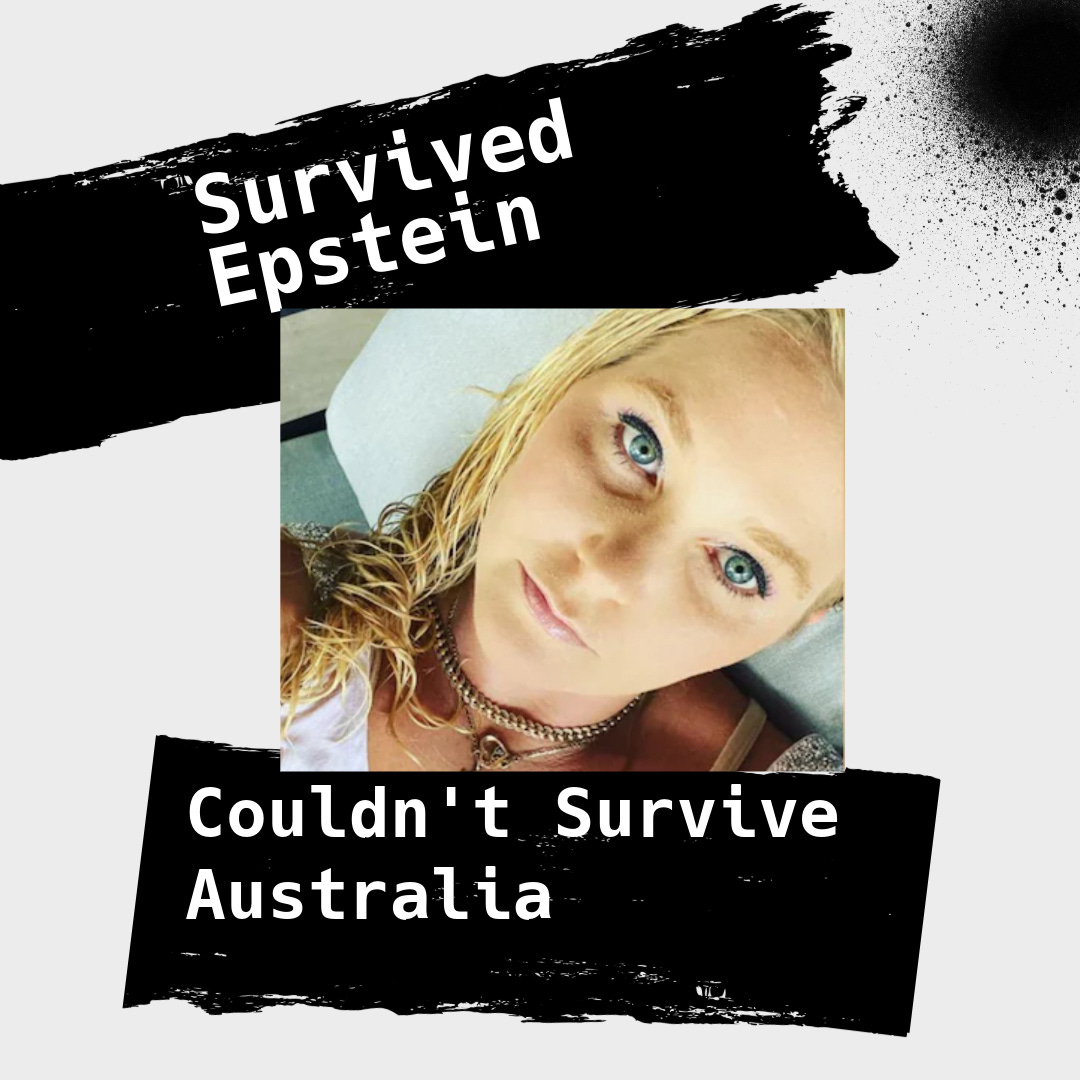
Virginia Giuffre Survived Epstein But Not Australia
Today we're revisiting the aftermath of Virginia Giuffre’s death — the woman whose name became synonymous with the fight for justice for the Epstein survivors. But why did Australian police fail her?

The story of Epstein survivor Virginia Giuffre doesn’t end with her passing. Her death without a will has created a legal labyrinth and its circumstances are pulling her estate, legacy and voice back into the spotlight.
In the coming months and years, the outcome of these proceedings will reshape what remains of her short but meaningful life.
Virginia, a mother-of-three, died on April 25 at her country property outside of Perth, Australia. She was aged just 41 at the time of her passing.
At the time, the state she was living in, Western Australia, was also facing its worst year ever of domestic violence offences (on track to exceed 40,000) and the legal resources were described as “severely lacking.”
Because Virginia was estranged from her husband of almost 24 years, Robert Giuffre. The family court was told last year that she was in the process of drafting a new will when she died.
According to The Daily Mail, she emailed her lawyer to say she did not want her spouse to have any of her money after he initiated divorce proceedings two months before she died.
Separately, Ms Giuffre’s brothers Sky Roberts and Danny Wilson are now challenging her estranged husband Robert Giuffre over his right to her funds, according to The Telegraph.
Ms Giuffre’s estate includes a rumoured $22 million settlement paid to her by the disgraced former Prince Andrew and the proceeds of her autobiography Nobody’s Girl.
Her American family said in a statement: “It is with utterly broken hearts that we announce that Virginia passed away last night at her farm in Western Australia. She lost her life, after being a lifelong victim of sexual abuse and sex trafficking,” the statement read.
“In the end, the toll of abuse is so heavy that it became unbearable for Virginia to handle its weight.”
It was clear she was losing the battle against her lifetime of trauma
in the months before her death. At the end, said she had lost hope because she was unable to see her children.
This was a direct consequence of the Western Australian police deciding to apply for a protection order against her on behalf of her estranged husband, and then charging Virginia with breaching it.
In an Instagram post from March 22, 2025, Ms Giuffre shared photos of her children and suggested she was unable to see them.
“My beautiful babies have no clue how much I love them,” she wrote.
“I miss them so very much. I have been through hell and back in my 41 years but this is incredibly hurting me worse than anything else.
“My heart is shattered and every day that passes my sadness only deepens.”
In addition, she alleged her husband had beaten her, but police did not file charges. Mr Giuffre has not commented on the allegations and we are making no such suggestions.
Virginia had appeared in court for allegedly breaching a family violence restraining order just weeks before claiming she had days to live following a bus crash.
The alleged breach happened in early February and her first appearance at the Magistrates Court in Joondalup, WA, was on March 14.
No plea was entered at the hearing and the matter was listed for April 9.
We have yet to hear from the Giuffre family in the wake of her death other than by way of “no comment.”
Why did the WA police fail Virginia Giuffre and others like her?
There are several examples where victims flagged serious risk (including mention of firearms, threats, instability) and believe the police did not act with sufficient urgency or use the full range of protective orders. For example, the case of Ariel Bombara and her mother: they say they alerted police repeatedly, requested a 72-hour protective order, but were refused; subsequently a double murder-suicide occurred.
In that case, an internal review found eight officers failed to discharge their duties, according to WAPOL Code of Conduct.
Also, the state government had a “flagship” policy targeting repeat offenders (including GPS monitoring) which has been reported as poorly implemented or having major cracks.
A report by the Office of the Ombudsman Western Australia found that during response to family and domestic violence incidents, WAPOL provided information and advice about violence restraining orders (VROs) only 25 % of the time in one reviewed sample.
The report also noted victims were asked to consent to information sharing with support/referral agencies in fewer than half of occasions (40 % in that sample).
This suggests a gap between policy (that victims should be advised of VROs, supports etc) and actual daily practice in the field.
3. Failures in risk assessment and protective action
The high volume of incidents places enormous pressure on police, courts, support agencies, and the monitoring and enforcement of orders.
5. Enforcement of orders / breaches
One of the recurring criticisms is that even when VROs or police orders are in place, breach enforcement is inconsistent, and victims feel the order offers little real protection. While this is not always specific to WA, the challenge is certainly present in to the state. For example:
The general expectation is that if a restraining order is breached, it is a criminal offence.
But enforcement depends on police capacity, prioritisation, and victim willingness, and breaches can sometimes go unaddressed.
Structural/Policy Context
The Restraining Orders Act in Western Australia and accompanying regulations establish the framework for police orders and VROs.
WAPOL policy (COPS Manual) mandates attendance at the scene of any incident where an act of family and domestic violence is believed to have occurred, except in “exceptional circumstances”. In one review, WAPOL complied in 96 % of cases in a sample of prior fatalities.
But the policy also relies on the incident being properly classified, reported, and recorded as family/domestic violence, and the victim/s being given information and support — this is where gaps were found (e.g., DVIR submission rates, advice to victims).
For Aboriginal and/or remote communities, the Ombudsman flagged structural barriers: cultural appropriateness of the process, geographic distance, access to legal advice, and less use of VROs.
The coercive control discussion paper by the WA Government is relevant: it acknowledges that non-physical behaviours (emotional, psychological, isolation, financial abuse) are significant forms of family violence, and police responses must adapt.
What happened to the millions of dollars she had? Common, money doesn’t just vanish.